
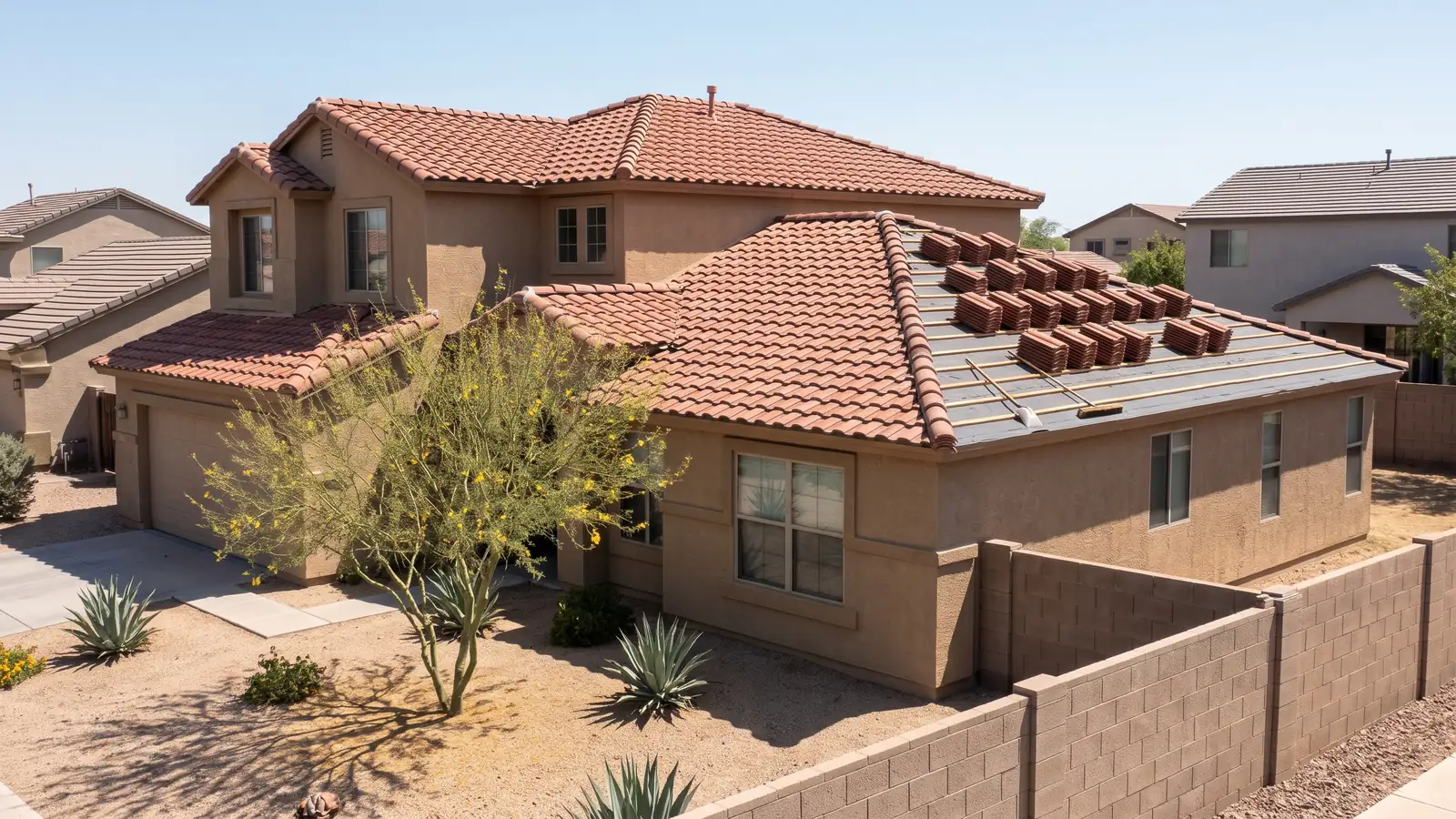
Tile roofing in Gilbert, AZ
Tile Roof Repair in Gilbert, AZ
- Typical bill: most tile repairs run $500 to $2,500, or $5 to $25 per sq ft of roof worked on.
- Minimum charge: some roofers set a $300 to $500 floor for any repair visit.
- Paperwork: in Arizona, a repair contract over $1,000 has to be in writing; the required contents are listed in the ROC section below.
- License class: residential roof work falls under the R-42 roofing license, or the dual CR-42.
Broken tile, a slipped course or a loose ridge: Tile Roofing Gilbert hands your request to an independent Gilbert-area roofer for whichever one you're dealing with. A national guide supplied the costs, so hold a quote against them rather than reading them as your price. It helps to say whether anyone else has been on the roof lately.
Tile Roof Repair by Problem
Below are six problems a tile repair can involve, in short form so you can tell which one you have. Where this site has a page that goes deeper, the section links to it.
Broken or Cracked Field Tiles
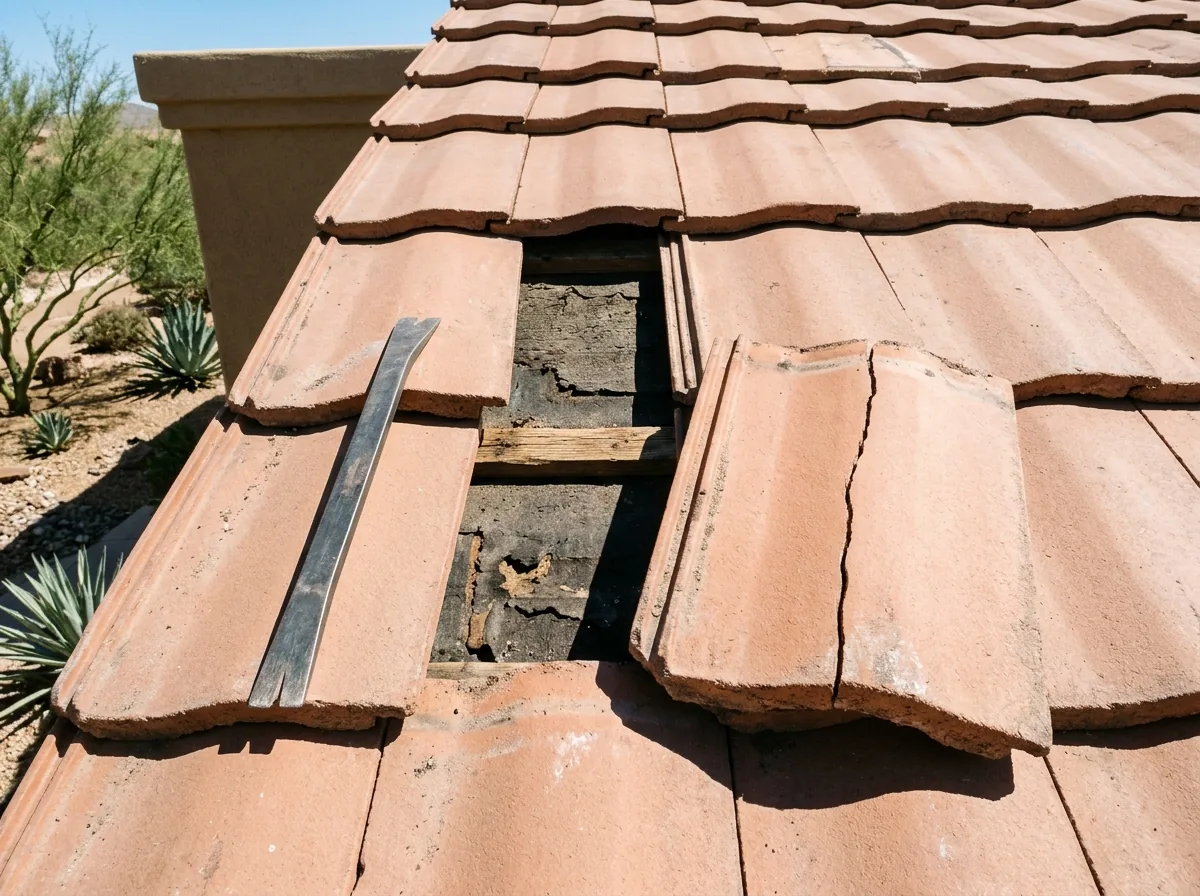
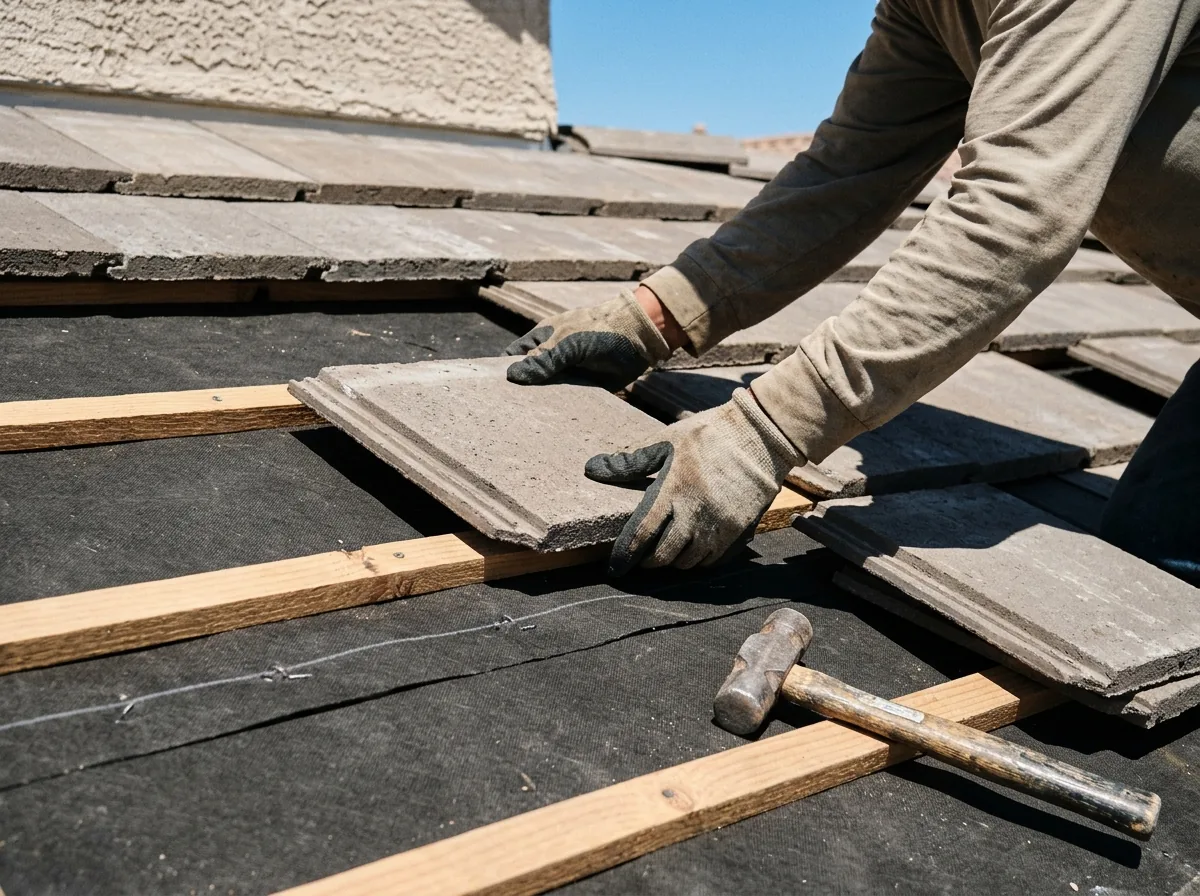
The standard fix, in the tile industry's manual, is to pull the broken tile, cut any old fasteners, repair the underlayment underneath and slide a new tile in. Where there are no battens, a 12 x 6 inch piece of 1/2-inch plywood gets nailed to the deck to hang it on, or the tile is set with mastic, hooks, wire or approved adhesive. Per-tile prices and the crack types that can be glued are on the broken roof tile repair page.
Slipped Tiles
A tile that slides down its course leaves a gap above it and exposes felt. HomeGuide blames extreme weather, pests, age and long sun exposure for loose tiles. One or two are a quick reset; a scatter of them across a slope is a different conversation, covered on the broken tile page.
Ridge and Hip Caps
Ridge and hip caps cover the joints at the top of the roof, and in the tile industry manual's details each cap's nose sits in a bead of roofer's mastic. Loose or missing caps leave those joints open to wind-driven rain. Re-bedding and dry-set options are on the ridge cap repair page.
Valleys, Flashing and Pipe Jacks
Building Advisor counts flashings, along with the underlayment, as the primary water barrier on a tile roof, and the flashing sits at the joints: valleys, walls, chimneys and vent pipes. When a stain shows up inside, flashing is the first suspect after broken tile. The metal specs and repair prices are on the valley and flashing repair page, and finding the actual entry point is on the leak repair page.
Underlayment Patch at One Section
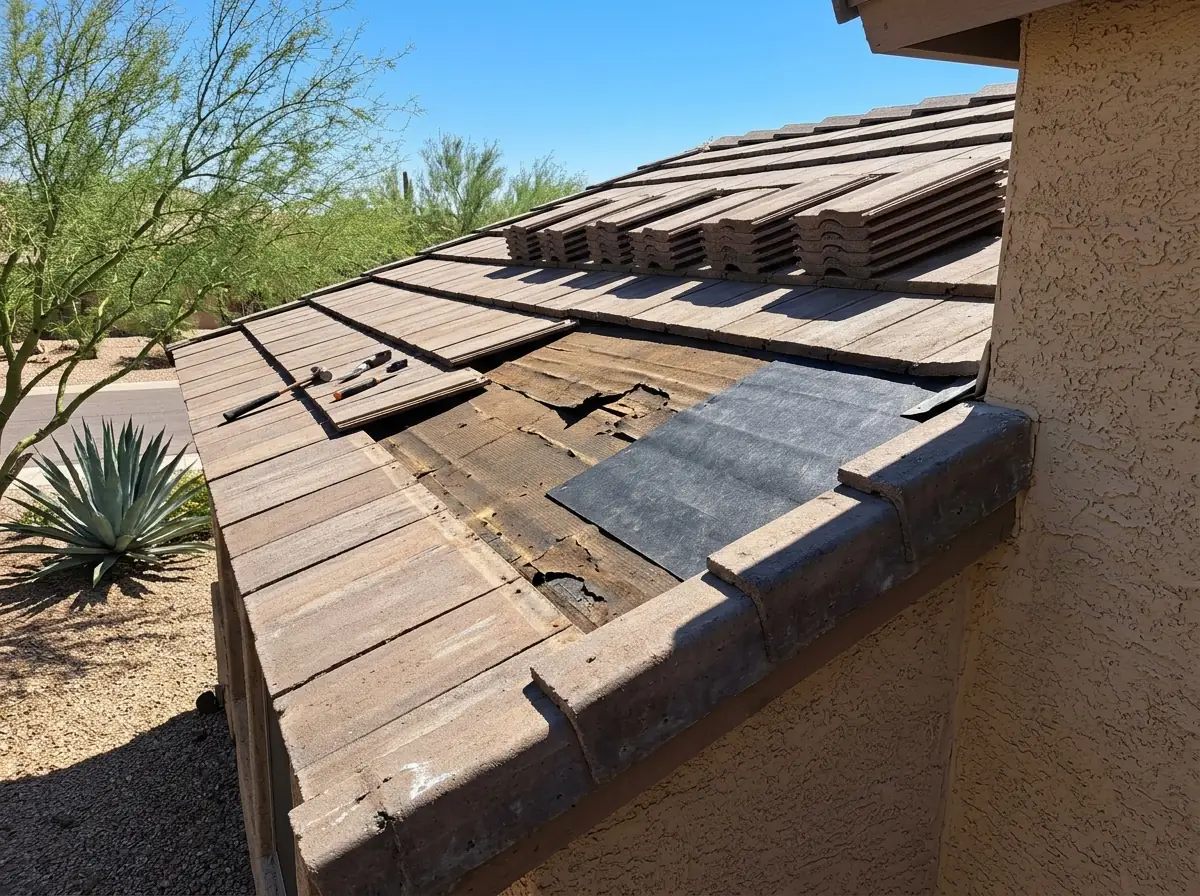
Sometimes a roofer lifts a few rows, finds the felt torn in one spot and patches it, lapping new underlayment under the old above and over it below. It's a fair repair when the rest of the felt is still flexible. If the felt crumbles at the edges of the patch, the patch won't hold for long, and the honest quote is a partial or full re-lay.
Damage From Other Trades Walking the Roof
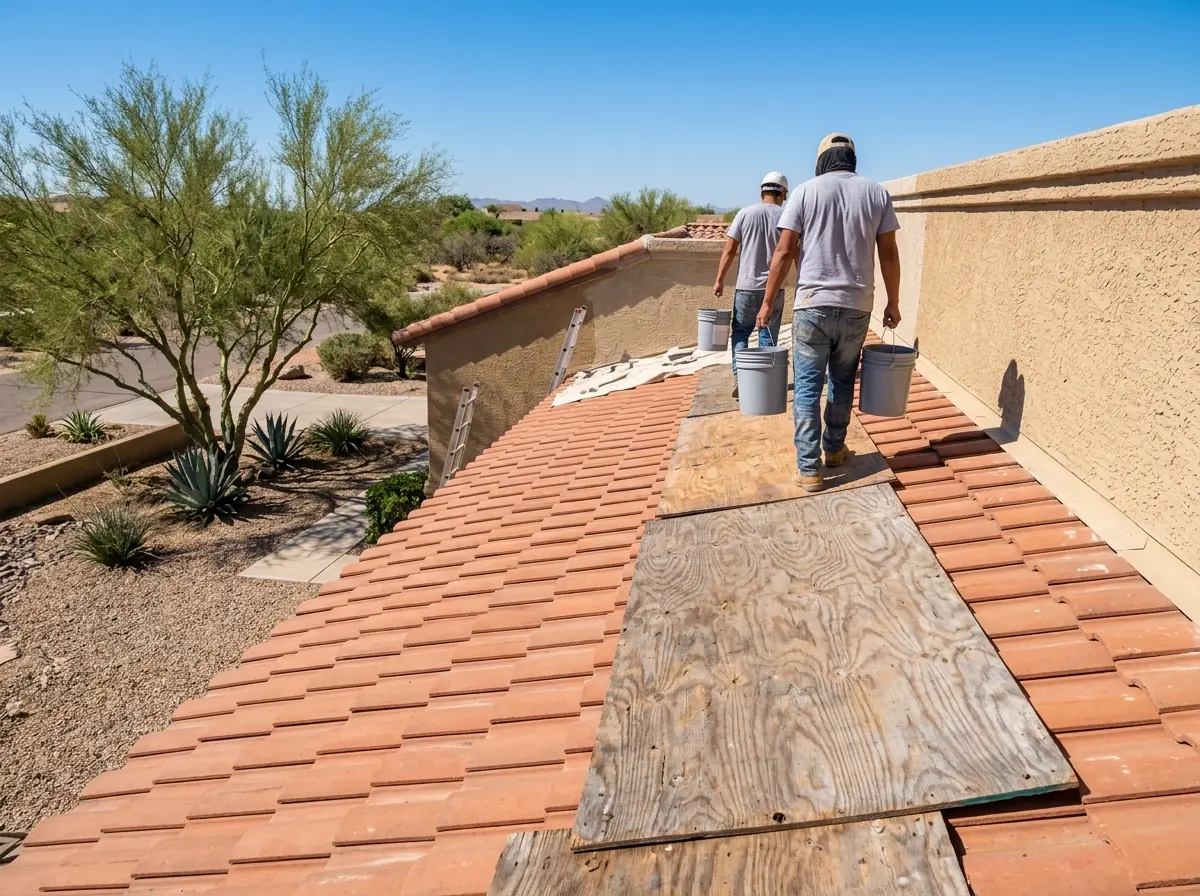
Anyone who walks a tile roof can break it, and satellite, solar, painting and pest crews all go up there. Most tile makers don't warrant breakage from foot traffic, according to the tile industry's walkability brief, which says to step on the bottom 3 inches of each tile and to stay off hips and valleys, where cut tiles are harder to replace. For work on walls next to the roof, the manual says to cover the tile with secured plywood. Ask any trade going up to do the same, and check the roof after they leave.
Why Gilbert homeowners and HOAs call Tile Roofing Gilbert
- One request goes to one roofer, never to a call list
- Free to send, with nothing to sign until you have a written price
- Ask to see the R-42 or CR-42 license number on the contract
- Ask how many replacement tiles the price allows for
- You pay nothing for the introduction
Tile Roof Repair Contracts and ROC Licenses
Arizona's Registrar of Contractors (ROC) licenses roofers, and a few rules decide whether a repair is on solid ground.
License classes
R-42 covers residential roofing, C-42 commercial roofing and CR-42 both. The "R" in a residential class limits the holder to the work in that license title.What it takes
each roofing class requires four years of experience plus a statutes-and-rules exam and a trade exam.Check it
look the contractor up with the ROC's Contractor Search and confirm the class covers the work in your contract. Contracting without a license in good standing is unlawful.The $1,000 exemption
casual, minor work under $1,000 in total doesn't need a license, but the exemption never applies to work that needs a local building permit.Contract contents
over $1,000, the contract must state the contractor's name, address and license number, the work, the total including tax, any deposit, each progress payment and the stage it's tied to, the completion date and your right to complain to the ROC. You get a copy of everything you sign and a receipt for any cash.Bond and insurance
a license requires a bond; apart from workers' comp, the ROC doesn't require insurance. Ask for proof of liability coverage separately.
The ROC's own hiring advice is short and worth following: get written estimates from at least three contractors, agree on a payment schedule, never pay in cash, make checks out to the company named in the contract and don't let payments run ahead of the work. It also notes that special-order materials can need paying up front, which rarely applies to a repair using stock tile.
Tile Roof Repair or Re-Lay: Where the Line Falls
A repair fixes a spot. A re-lay fixes the whole water barrier. The cost gap is why the choice matters: HomeGuide puts most repairs at $500 to $2,500, while Angi's Phoenix-area figure for the underlayment alone averages about $2 per sq ft, or roughly $4,000 on a 2,000 sq ft roof. Angi doesn't say whether lifting and relaying the tile is in that number, so ask a roofer to price the whole re-lay.
Repair makes sense
when the damage is local, the felt around it is still flexible and the roof hasn't leaked elsewhere.A re-lay makes sense
when several slopes have slipped or broken tile, since HomeGuide notes that many loose tiles may mean the roof needs replacing, or when the felt tears at every spot the roofer opens.Replacement makes sense
only when the tile itself is failing; see tile roof replacement.
In Gilbert the question comes up on a lot of roofs: the Census Bureau puts the town's median year built at 2004, so on half its housing the original felt, if it's still there, is past 20 years old. Comparing the felt at the repair spot with felt well away from it helps decide which side of the line a roof is on.
Frequently asked questions
The pest control tech walked our roof and now there are cracked tiles. What should we do?
Get the broken pieces replaced soon. The tile industry warns that broken tile lets water and sun reach the underlayment, and most tile makers don't warranty breakage from foot traffic. Photograph the damage, tell the company that was up there, and ask the roofer to check the felt under each cracked piece while it's out.
A handyman offered to swap a few tiles for $400. Does he need a license?
Arizona exempts casual, minor jobs under $1,000 total from licensing, but not work that needs a local building permit. A small tile swap can fall under that exemption. Anything bigger, or anything that turns into underlayment work, belongs with an R-42 or CR-42 roofer you can look up on the Registrar of Contractors' site.
How many repairs before it makes more sense to redo the roof?
There's no fixed count, but a pattern helps. HomeGuide notes that many loose or slipped tiles can mean the roof needs replacing, and repeat leaks in different spots usually point to underlayment that's worn out roof-wide. When repair quotes start to approach a re-lay of the worst slope, get both prices.
What should a written repair estimate show?
Over $1,000, Arizona law sets out what the contract must contain, starting with the contractor's license number; the full list is in the ROC section below. Under $1,000, ask for the same items anyway.
If a repair goes wrong, is there any protection beyond the contractor's word?
Yes. Arizona's Residential Contractors' Recovery Fund can pay homeowners who hired a licensed residential contractor and suffered damage from a violation, up to $30,000 per award and $200,000 per license. It doesn't cover unlicensed work, which is one more reason to check the license before anyone climbs up.