
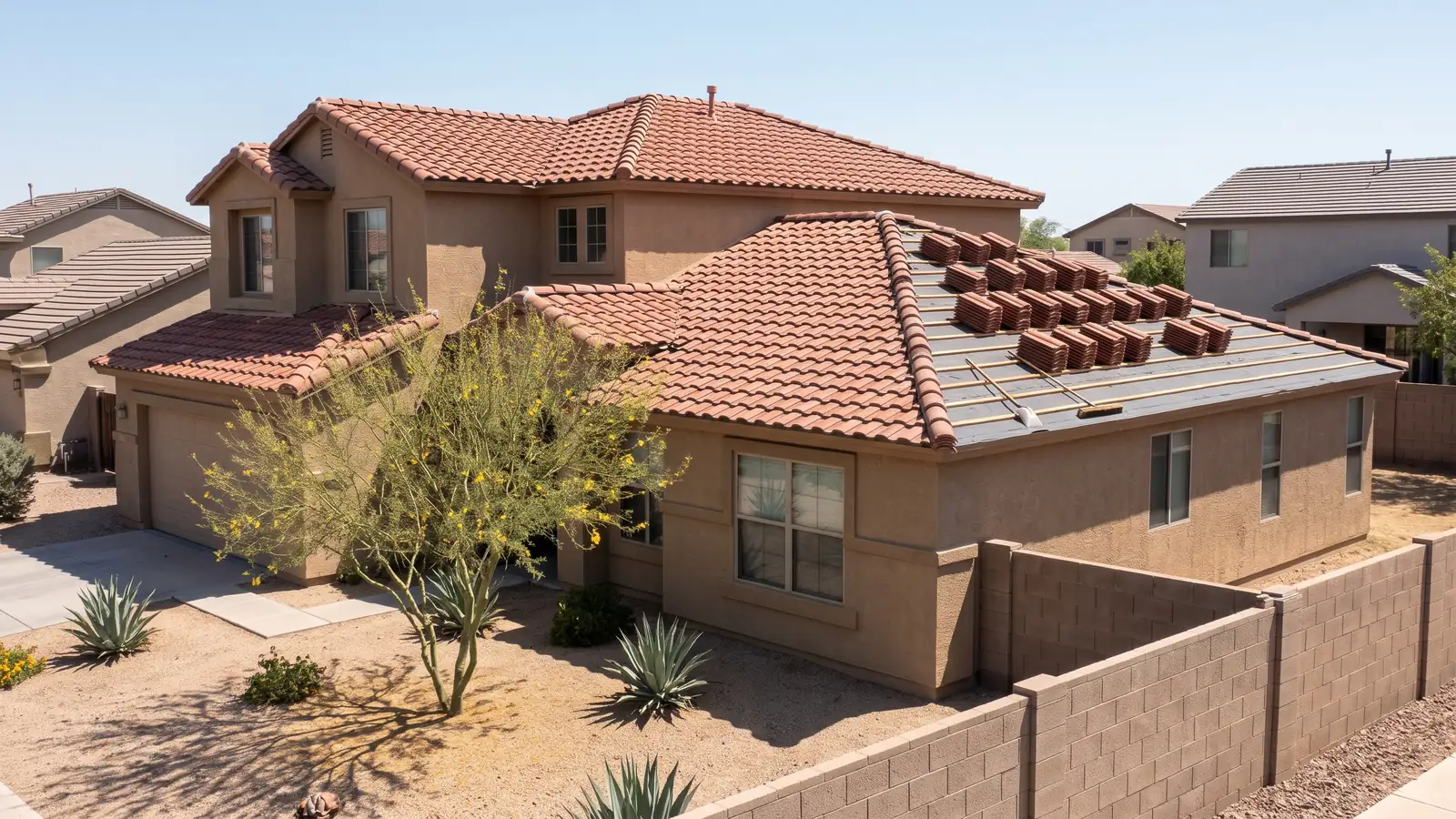
Tile roofing in Gilbert, AZ
Tile Roof Underlayment Replacement in Gilbert, AZ
- Phoenix-area price: underlayment replacement averages about $2 per sq ft, with most jobs between $1 and $3.
- National range: $0.75 to $4.00 per sq ft, which works out to $1,500 to $8,000 on a 2,000 sq ft roof.
- How long the new layer lasts: two plies of rated No. 30 felt are good for 20 to 30 years; an SBS-modified 40 lb sheet can add 50 to 100% to that.
- What goes back on: sound tile can be relaid, cracked or broken tile can't, and rusted or worn flashing has to be replaced.
Tile Roofing Gilbert is a free referral line to a single independent roofer in town for the felt under your existing tile. Those prices are cost-guide averages; nobody has measured or bid your roof. The one detail worth giving up front is whether solar panels sit on the slopes that need new felt.
Tile Roof Underlayment Replacement Options
Underlayment is the part of a tile roof that actually keeps the water out. Building Advisor puts it plainly: the underlayment and flashings form the primary water barrier, and the tile mostly shields them, so the tile usually outlives both. The jobs below are the ways that barrier gets renewed, from the whole roof down to a single valley.
Full Lift and Re-Lay
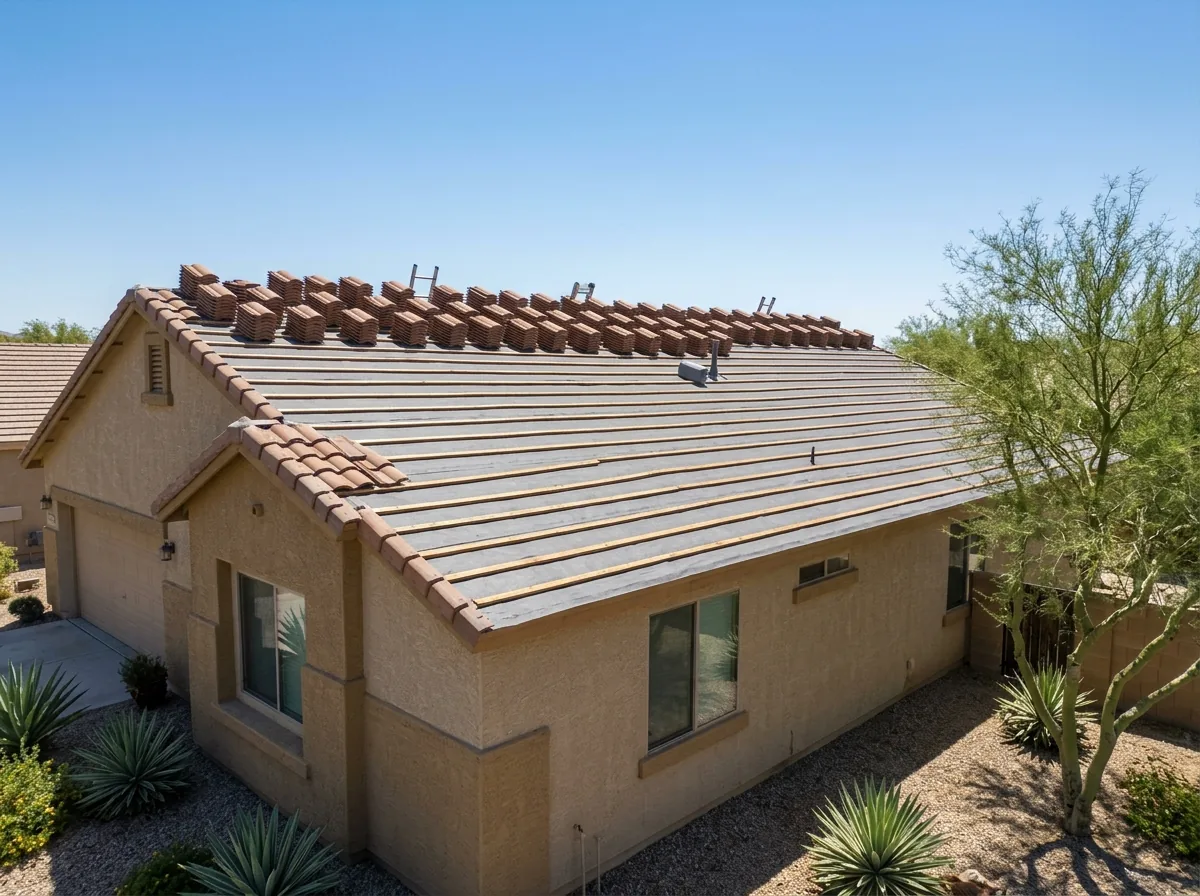
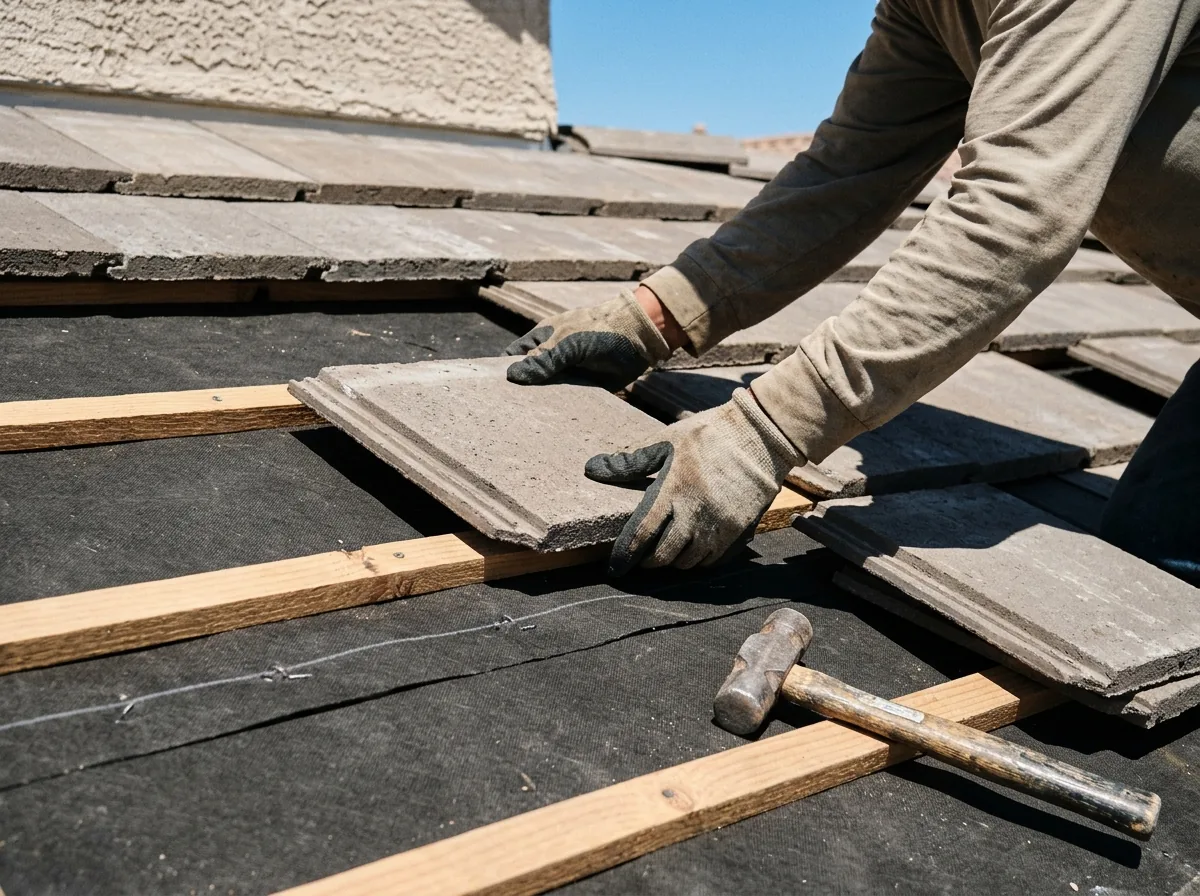
In a lift and relay, the tile comes off, new underlayment goes down, and the original tile goes back on. It's the usual answer when the tile is sound but the felt has dried out across the roof. The tile industry's installation manual lists three rules for the re-roof itself: cracked or broken tile comes off the roof, damaged or rusted flashing gets replaced, and the structure has to carry the tile load.
- Typical Phoenix-area price for the underlayment work: about $2 per sq ft, $1 to $3
- National guide range: $0.75 to $4.00 per sq ft
Partial Re-Lay of One Slope or a Valley Run
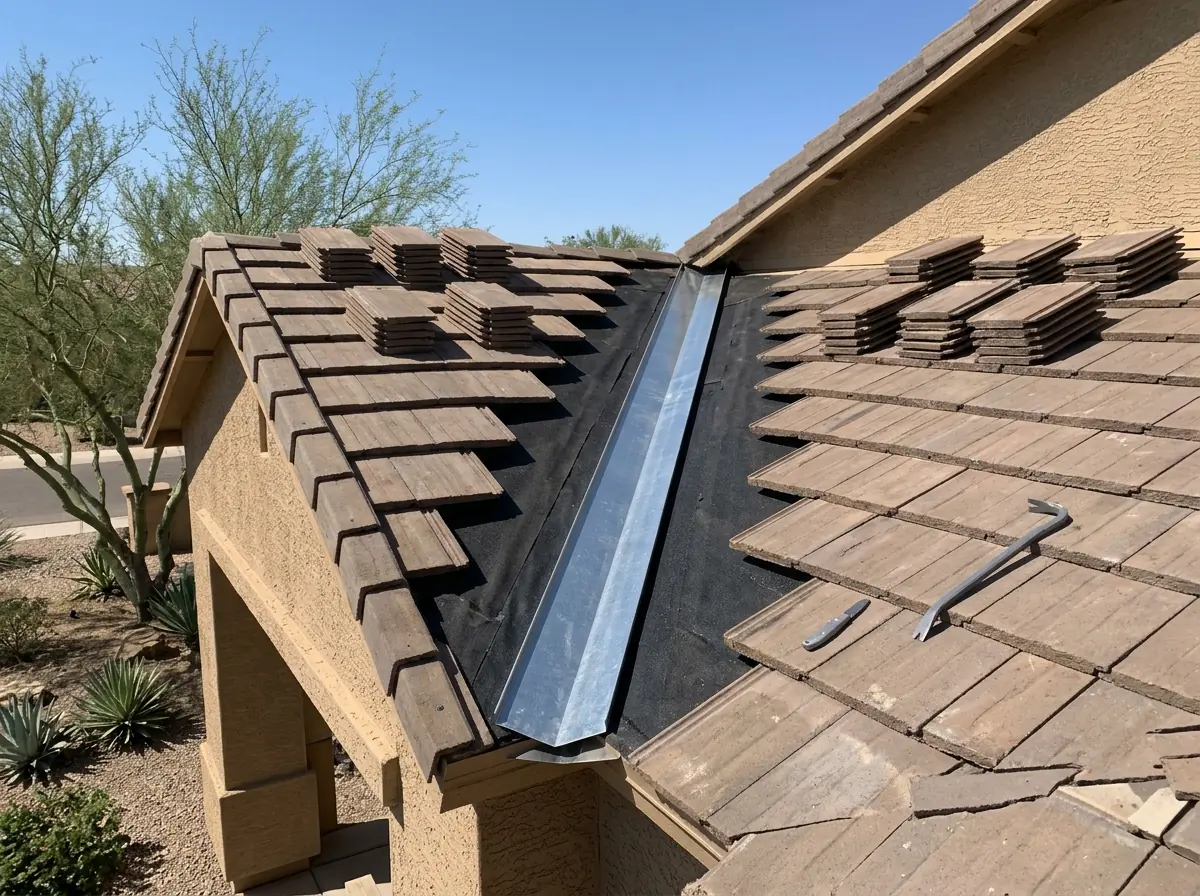
When one slope or a valley fails early, a roofer can lift only that area and re-felt it. That's cheaper today but leaves the rest of the roof on its original underlayment. HomeGuide's repair guide lists underlayment replacement as a repair line at $1,100 to $9,000. The new sheet has to lap onto the old one properly: the code calls for 2-inch head laps and 4-inch end laps on felt at 4:12 and steeper.
Two Plies of ASTM No. 30 Felt
Two layers of asphalt felt rated to ASTM D226 Type II is the traditional system and the minimum Building Advisor recommends under tile. The catch is the label. Unrated "30-pound" felt can weigh only 15 to 20 lb per square, while rated No. 30 weighs close to 30.
- Expected life of two rated plies: 20 to 30 years
- Asphalt felt is water-resistant, not waterproof
- Ask to see the rating on the roll wrapper before it goes down
Synthetic Underlayment
HomeGuide rates synthetic and rubberized underlayments waterproof and more resistant to UV, wind, tearing and extreme heat, with a life of 25 to 30 years against 20 to 30 for felt. The tile industry manual lists ASTM D4869 Type IV and D1970 self-adhered sheets alongside No. 30 felt. Ask which code approval the product carries for use under tile, since the IRC table names specific standards.
High-Temperature Self-Adhered Underlayment
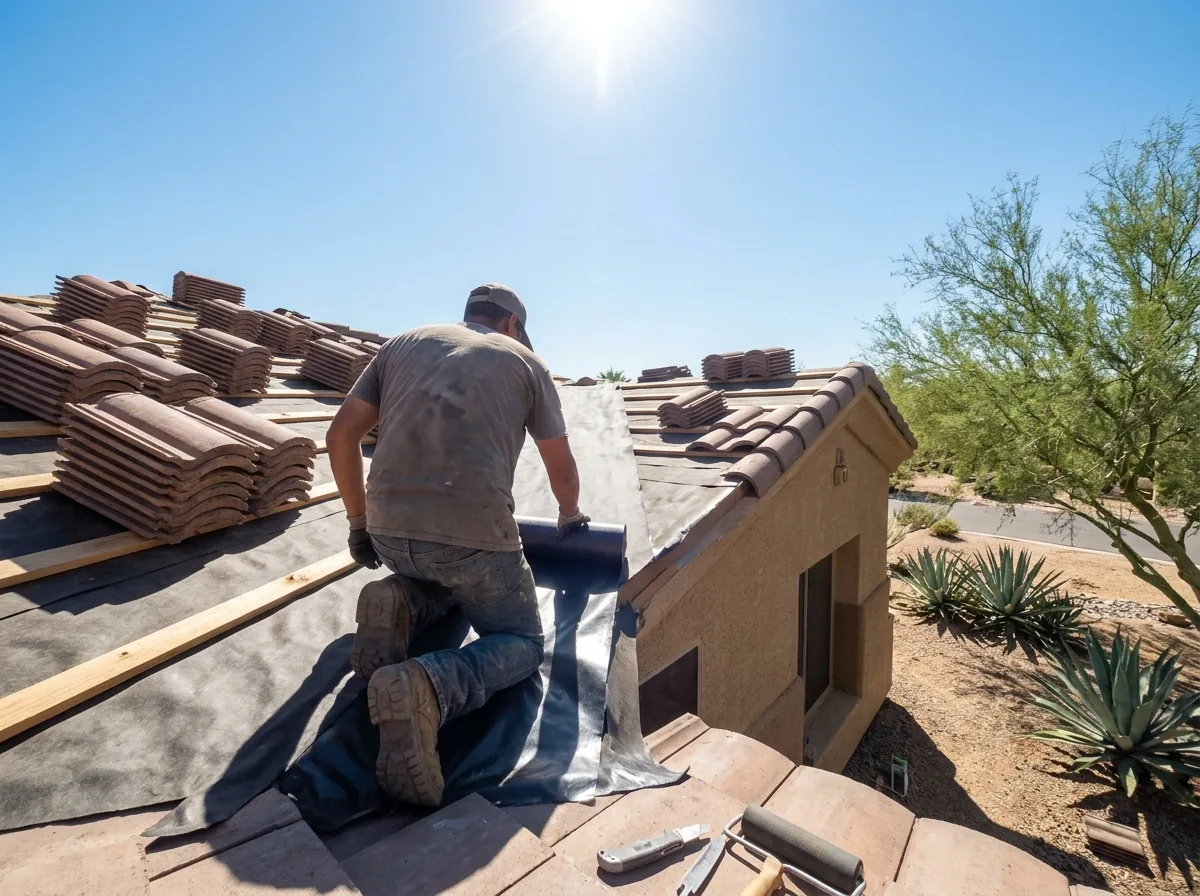
Peel-and-stick membrane seals around nails, and makers pitch it as reinforcement at perimeters and flashing details. In Arizona heat it has to be a high-temperature product. One tile-specific sheet, Polyglass Polystick TU Plus, is approved to 265°F and rated for up to 180 days of exposure while tile sits stacked on the roof.
- Code allows ASTM D1970 self-adhered underlayment under tile when both manufacturers' instructions are followed
- Drawback: it's nearly impossible to peel off at the next re-roof, which can mean new sheathing then
Batten and Flashing Renewal During a Re-Lay
A re-lay is the cheapest moment to fix everything the tile hides. The code requires rusted, damaged or deteriorated flashings, edgings, outlets and vents to be replaced when tile is reinstalled. Battens are usually nominal 1x2 lumber, and the manual calls for drainage under them, either a 1/4-inch riser at each nail or 4-foot battens with 1/2-inch gaps. Rotten deck boards are a separate line item (decking replacement), and the valley metal details are on the valley and flashing page. If the tile itself is worn out, a re-lay is the wrong job: see tile roof replacement.
Why Gilbert homeowners and HOAs call Tile Roofing Gilbert
- One request goes to one roofer, never to a call list
- Free to send, with nothing to sign until you have a written price
- Ask to see the R-42 or CR-42 license number on the contract
- Ask how many replacement tiles the price allows for
- You pay nothing for the introduction
Tile Roof Underlayment Rules in the 2018 IRC
Gilbert enforces the 2018 International Residential Code with Town amendments, and Chapter 9 sets the floor for any tile underlayment job, permit or not.
Minimum slope
clay and concrete tile need at least 2.5:12 (R905.3.2).Double underlayment
required from 2.5:12 up to 4:12 (R905.3.2).Listed products
ASTM D226 Type II, ASTM D2626 Type I or ASTM D6380 Class M mineral-surfaced roll roofing; ASTM D1970 self-adhered sheets are allowed as an alternative (Table R905.1.1(1), R905.1.1).At 4:12 and steeper
at least one layer, lapped 2 inches, end laps 4 inches and offset 6 feet (Table R905.1.1(2)).Tile fasteners
corrosion-resistant nails of at least 11 gauge with a 5/16-inch head, long enough to go 3/4 inch into the deck or through it (R905.3.6).Perimeter tile
at least one fastener per tile; on solid sheathing without battens, one per tile at any slope (R905.3.7).Reinstalling tile
sound tile may go back; damaged, cracked or broken tile may not (R908.5).
Low patio roofs and porch tie-ins are where these rules bite. A section near 3:12 needs the double layer, and anything under 2.5:12 shouldn't carry tile at all.
Tile Roof Underlayment Age on Gilbert Houses
Gilbert's median home was built in 2004, and 56.6% of its housing units, apartments included, date from 1990 through 2009, per the Census Bureau's 2024 estimates. If a house in that band still has its original felt, the felt is now 17 to 36 years old. The two lifespan figures differ: Building Advisor gives two rated plies of No. 30 felt 20 to 30 years, while Rosie on the House gives underlayment in general 8 to 20. Against either one, many of those original roofs are near or past the end of the range, and HomeGuide notes that extreme heat shortens underlayment life.
Age alone doesn't make the call. A roofer should lift tiles at the spots that wear first, usually valleys, eaves and around vents, and show you photos of what's underneath. If the felt tears or crumbles in hand there, a re-lay is likely the right job. If it's still flexible, a repair now and a re-lay later can make more sense, and a leak repair visit is the place to start that conversation.
Frequently asked questions
Our tile still looks new, but the house is 20 years old. Do we really need new felt?
Possibly. Tile usually outlives the layer under it. Building Advisor gives two plies of rated No. 30 felt 20 to 30 years, and Rosie on the House puts underlayment at 8 to 20. Lifting a few tiles at the valleys and eaves lets a roofer check the felt itself.
Will all our tile go back on after the re-lay?
Most of it, if it comes off whole. The 2018 code Gilbert enforces lets sound clay or concrete tile be reinstalled but bars cracked or broken pieces, so some replacements are normal. Ask the roofer how many spare tiles the quote allows for, and where they'll come from if your profile is no longer made.
Is synthetic underlayment worth paying more for than felt?
It depends on the slope and the product. HomeGuide rates synthetic and rubberized underlayments waterproof and tougher against UV, wind and heat, where asphalt felt is only water-resistant. Felt is still code-listed under tile, and two plies of rated No. 30 is the minimum Building Advisor recommends. Ask to see the product's data sheet and its approval for use under tile.
Can the roofer re-felt just the back slope where the leak is?
Yes, a re-lay can cover just one slope or one valley run. The catch is the seam: the new underlayment has to lap correctly onto the old, and the untouched slopes are the same age as the one that failed. Ask whether the price per square foot changes if you do the whole roof at once.
Do we need a Gilbert permit to replace the underlayment?
Not for a like-for-like re-lay. The Town exempts re-roofing that needs no structural change from a building permit. The code still applies to the work, though, so the slope, underlayment and flashing rules below hold either way. See the replacement page for when a permit does come into play.